Wednesday, January 02, 2013

The 2012 Film Tally


On the BIG screen

This includes everything I saw in the theater. The X, if present, refers to the repeat viewings in the calendar year.

  1. My Week with Marilyn A
  2. The Girl with the Dragon Tattoo A
  3. Tinker Tailor Soldier Spy C-
  4. Carnage B
  5. The Artist X2  A+
  6. Le Havre B+
  7. A Dangerous Method B+
  8. Shame A
  9. Haywire B
  10. The Iron Lady C+
  11. Chronicle B+
  12. War Horse B+
  13. Moneyball A
  14. The Tree of Life B+
  15. The Descendants A+
  16. Hugo A+
  17. The Help A-
  18. Extremely Loud and Incredibly Close D-
  19. Midnight in Paris A+
  20. Pina B
  21. Red Tails B+
  22. John Carter C
  23. The Hunger Games B
  24. Silent House C+
  25. Bully B
  26. The Cabin in the Woods B
  27. Mirror Mirror B
  28. Titanic A+
  29. Joe vs. the Volcano A-
  30. The Truth about Beauty and Blogs B
  31. Phunny Business: A Black Comedy A-
  32. Big Fan A-
  33. Kinyarwnda C+
  34. Terri A
  35. On Borrowed Time B
  36. Wild and Weird A
  37. A Seperation A+
  38. Higher Ground A-
  39. Patang C+
  40. Take Shelter A
  41. Citizen Kane A+
  42. Jiro Dreams of Sushi B+
  43. Damsels in Distress B-
  44. The Avengers A
  45. Dark Shadows C
  46. Attack the Block B+
  47. Brainstorm B
  48. The Captains B-
  49. Electroma F
  50. The Green Slime Z
  51. Battle Royals B+
  52. Manborg D
  53. Source Code B+
  54. Reptilicus Z
  55. They Live B
  56. Men in Black 3 A-
  57. Bernie A-
  58. Snow White and the Huntsman D
  59. God Bless America B
  60. The Sound of My Voice B
  61. Rock of Ages C
  62. Brave A-
  63. Magic Mike B+
  64. The Birdman of Alcatraz B
  65. Ted A-
  66. The Amazing Spider-Man C
  67. Moonrise Kingdom X2 A+
  68. To Rome with Love B+
  69. Savages A-
  70. The Dark Knight Rises X2 A
  71. The Great Escape A
  72. Girl Crazy A-
  73. Beasts of the Southern Wild  B
  74. Hope Springs A-
  75. Mary Poppins A
  76. Murder on the Orient Express B
  77. The Bourne Legacy B-
  78. The Godfather A+
  79. The Godfather Part II A+
  80. The Godfather Part III B+
  81. Cosmompolis D-
  82. Killer Joe B+
  83. Lawless B
  84. Paranorman B+
  85. Trouble with the Curve B+
  86. Total Recall C-
  87. Premium Rush B+
  88. Looper X2 A
  89. The Master X2 A-
  90. The Perks of Being a Wallflower A+
  91. Frankenweenie B
  92. Pitch Perfect B
  93. Argo X2 A+
  94. End of Watch B
  95. Arbitage A-
  96. The House at the End of the Street C+
  97. Lincoln A
  98. Cloud Atlas A
  99. Seven Psycopaths C+
  100. Wreck-It Ralph A
  101. Flight A-
  102. Samsara B+
  103. The Sessions A-
  104. Skyfall A+
  105. Hello I Must Be Going B+
  106. The Silver Linings Playbook A
  107. Meet Me in St. Louis A+
  108. The Life of Pi A
  109. Anna Karenina C+
  110. Rise of the Guardians B
  111. Hitchcock C
  112. Killing Them Softly D
  113. The Hobbit: An unexpected Journey B+
  114. Jack Reacher B+
  115. Django Unchained A


On the small screen

And this list encompasses everything I saw on TV, be it through cable, streaming or disc. Titles are for the most part unseen, although I did include some titles I had not seen in a long time. 


  1. Margie B
  2. It’s Kind of a Funny Story B
  3. The Girl with the Dragon Tattoo (TV cut) A-
  4. Captains Courageous A-
  5. The Killing A
  6. Boys Town B
  7. Reel Injun B
  8. People Will Talk B+
  9. Interview with the Assassin B
  10. The Debt B+
  11. Keeper of the Flame B
  12. Sweet Dreams C+
  13. Warrior B+
  14. 21 Hours at Munich B
  15. Another Woman B
  16. Shark Night C
  17. Being Elmo A-
  18. MIldred Pierce A
  19. Make It Happen C
  20. Megamind B+
  21. Corman’s World A-
  22. Tabloid A-
  23. Texas Killing Fields C+
  24. The Swell Season A-
  25. Silkwood B+
  26. Witness to Jonestown A-
  27. Second Jonestown doc A
  28. Dolores Claiborne B
  29. 21 Jump Street B+
  30. Side By Side A
  31. The Executioners Song A-
  32. Catching Hell A
  33. Little Shop of Horrors A-
  34. We Need to Talk About Kevin A-
  35. The Girl C+
  36. The Life Before Her Eyes C+
  37. The Five-Year Engagement B
  38. Safety Not Guarenteed B+
  39. Seeking a Friend for the End of the World B
  40. Strange Fruit B+
  41. The Boy in the Plastic Bubble B+
  42. Ruby Sparks A-
  43. Cleanflix B+
  44. Key Largo A-
  45. Bananas A-
  46. The Circus A-

Thursday, December 13, 2012

The Hobbit: An Unexpected Journey

Probably the best compliment I can give Peter Jackson's first Hobbit movie is that I now understand the need for two movies. However, I remain unconvinced of the need for three.

My eyebrows raised when it was announced The Hobbit would be split in two, considering The Hobbit is shorter than any of the Lord of the Rings books, and each Rings book only got one movie. (Maybe one and a half if you count the extended editions.) Extending it into three movies makes it sound like the third movie ought to be subtitled, "Journey to the Center of the Wallet."

On the basis of this first movie, however, I will say the time was well spent, if somewhat overspent. Jackson crams so much detail into the story that at times he weighs it down, especially in the first hour. Most of the dwarves blended into each other, and I could have done without quite so many songs. And since we're taking all this time to drink in all this detail, why doesn't Jackson explain why Gandalf can only super-bomb a horde of ugly things only once?

It seems like Jackson and his co-writers Fran Walsh, Phillipa Boyens and Guillermo del Toro made the movie for Tolkein geeks like them - people who know can speak the languages and who know the thread counts of the costumes. If the rest of us got bored, we'd have to grin and bear it.

Fortunately, we don't have to bear it for too long. Once everyone leaves the shire, the movie picks up the pace, and Jackson's fluid camerawork is more exciting than ever. The viewpoint swoops and ducks to breathtaking effect, particularly in a battle between two giant stone mountains. Adding to the drama is the clever foreshadowing of the evil that will come into full flower later.

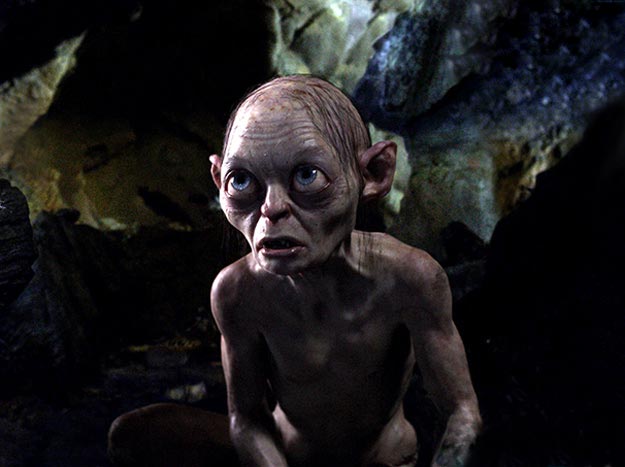
And even the quieter scenes become more effective in the second half. The game of riddles between Bilbo and Gollum plays wonderfully, alternating between laughs and chills. Gollum seems more alive and present than ever before. As excellent as the effects work was in the Rings movies, there still tended to be a slight remove between the digital creature and the real actors. Here, any blur between reality and fantasy vanishes into thin air.

Speaking of blur, or lack of same, I saw the movie in the much-discussed new format of 48 frames per second, double the normal rate. Theoretically, the idea is to improve the clarity of the images by eliminating motion blur, but sometimes it's clear to a fault. Indoor scenes, with less camera movement have that eerie "soap opera" effect where it looks too pristine to be true. In action scenes and long outdoor shots, however, the effect is indeed immersive. I would have to see the film in standard format to make a thorough comparison.

Luckily, the best parts of the film are good enough for a repeat viewing, especially in 3D. It's the best use of the format I've seen, along with Hugo and Avatar. Like Bilbo Baggins, I went in with fear, but came out glad that I went - even if I was a little worse for the wear.


GRADE: B+


Friday, November 16, 2012

REVIEW: Lincoln

Most people would rank Abraham Lincoln at or near the top of the roster of US Presidents. I would rank Steven Spielberg's Lincoln at or near the top of the roster of this year's movies.

And yet, it may not be quite the film people are expecting. It is not a Civil War epic. The ads prominently feature battle scenes, but those scenes are contained within the first five minutes of the film. If you want battles, watch Glory.

Nor is the movie truly a Lincoln biopic, despite its title. It does not follow the journey of the man from humble Illinois lawyer to mythical president. That story has been ably told before, via Abe Lincoln in Illinois and John Ford's Young Mr. Lincoln. The new movie focuses solely on the last few months of the president's life, and, more importantly, his battle to pass the 13th amendment that will abolish slavery.

And yet, Lincoln himself is very much front and center, because that particular battle embodies the man and his legacy. By focusing on this sliver of the man's life, Tony Kushner's screenplay illuminates Lincoln as he has never been before.

This is due in no small part to the masterful portrayal by Daniel Day-Lewis, who is now the definitive cinematic Lincoln. The actor is famous for burying himself in his roles, but he has never done so with greater impact than he has here. Daniel Plainview (There Will Be Blood) did not make me forget Bill the Butcher (Gangs of New York). Bill the Butcher did not make me forget Christy Brown (My Left Foot). But Abraham Lincoln very much made me forget Daniel Plainview, Bill the Butcher and Christy Brown. The actor reveals the president to be a Rubik's Cube of a man, a puzzle that is fascinating no matter what side he displays.

But Day-Lewis is not the only one who disappears into the film. So does Steven Spielberg. Lincoln is unlike any film the director has made before. He delved into this same time period in the underrated Amistad, but that film had visual sweep. Even Schindler's List, which was considered a major departure for Spielberg, had bravura sequences.

Spielberg keeps showy visuals and camera movements to a bare minimum. More than anything else, his new film is a chamber piece. It's essentially two hours-plus of people talking. But that talk crackles with energy and gamesmanship. The film means to make us a witness to history, and it's a riveting master class.

Spielberg is not typically thought of as an actor's director, but he has assembled a brilliant cast with a multitude of well-known names: David Strathairn, Joseph Gordon-Levitt, Jackie Earle Haley and Hal Holbrook, to name just a few. Chief among the supporting players is Tommy Lee Jones as abolitionist Congressman Thadeus Stevens. He passionately believes in outlawing slavery but has to swallow hard when he must compromise his principles and not do it in quite the way he wants. That issue is more than a little timely when partisan gridlock is the order of the day.

The film doesn't conquer all its own problems. I found the material involving Mary Lincoln (Sally Field) a distraction, as was the overextended ending. Spielberg has problems sticking his landings. It's no spoiler to say the film ends with Lincoln's assassination, but showing it is unnecessary. What's more important is what historian Shelby Foote meant when he said that "everything Lincoln did was calculated for effect."

That effect resonates even more thanks to this film.

GRADE: A


Wednesday, November 07, 2012

REVIEW: Skyfall

How great is Skyfall?

At the packed screening I saw, the movie got applause no less than three times.

In one astonishing long, unbroken shot, Javier Bardem takes the mantel of best Bond villain of all time, and never lets go.

It's the best-looking Bond movie bar none, brilliantly shot by the great Roger Deakins, who lenses most of the Coen brothers' movies.

The action scenes are fantastic, with Stuart Baird's punchy editing obliterating the memory of the confused blur that was Quantum of Solace.

Daniel Craig proves that the older and more rugged you get as Bond, the better.

The excellent screenplay by Neal Purvis, Robert Wade and John Logan, delves into Bond's early years in a way no other Bond film has.

The movie blends new technology with good old-fashioned ruthlessness, deconstructing the Bond mythos much the same way Christopher Nolan did in his Batman movies.

It's a bit light on Bond girls, and I missed that element, but only one Bond girl really matters here is Judi Dench's M. Enough said.

Q is back, played with just the the right touch of brashness by Ben Wishaw.

Another Bond favorite is back too. Again, enough said.

In 1999, director Sam Mendes made a film called American Beauty that so entranced me, I turned right around to see it again the same weekend.

In 2012, director Sam Mendes made a film that so thrilled me, I was disappointed I couldn't see it again immediately, since I saw it early.

How great is Skyfall?

It's one of the very best films of the the year.

GRADE: A+


Friday, November 02, 2012

REVIEW: Wreck-It Ralph


INSERT COINS

_ ONE READER  _ TWO READERS

GO!

Don't look now, but Disney just beat Pixar at its own game.

Wreck-it Ralph not only is terrific fun, it's the best movie made by Walt Disney Feature Animation since its glory days in the 90s. Heartfelt, visually dazzling and wonderfully clever, the movie tops such recent Disney efforts as Tangled and Pixar's Brave - both films I very much enjoyed -  but with reservations. Reservations are absent this time.

That's largely because, in a way, Disney has truly begun to assimilate Pixar and its storytelling techniques. All of Disney's feature films since Meet the Robinsons have been overseen to some degree by Pixar guru John Lasseter. But this is the first time Disney has truly mastered the mix of humor and heart that makes Pixar so potent. I expected to have fun, but not this much fun.

Like the Toy Story films, Wreck it Ralph takes kind of a behind-the-scenes look at a very familiar world. This time, it's the world of 80s/90s video games. Many people have said the game in the movie, Fix-It Felix, resembles Donkey Kong, and it does, but it most reminded me of another 80s game called Crazy Climber, the first game I can recall that talked. Your climber character said "Ouch" when people dropped things on its head, and then screamed "Oh nooooooo!" when you finally fell off.

I digress, but this movie was a nostalgic blast that constantly reminded me of games of yore. But even better, that conceit isn't just a gimmick. It's a doorway to a well-thought-out story where Wreck-It Ralph (John C. Reilly) tires of being a villain and jumps to other games to be more heroic. One of the other games is called Sugar Rush, which is like Candy Lane gone delectably berserk. There, Ralph meets the impetuous but endearing Vanellope (Sarah Silverman) who enlists Ralph's help to race in a go-kart game.

Wreck-It-Ralph blends the best of its Disney and Pixar fathers. Ralph's quest to be loved is not unlike the "I Want" quest of Disney princesses. And the relationship between Ralph and Vanellope is like a slightly more mature take on Sully and Boo in Monsters Inc. And just as Pixar made Larry the Cable Guy endearing, Wreck It Ralph pulls a similar miracle here with Sarah Silverman, who normally annoys me, but utterly won me over here.  For the first I laughed at loud at Oreos, and more than once, I had to adjust my 3D glasses because I had something wet in my eye.

So yes, it's emotional and flashy, in all the best ways. All the gameplay will appeal to boys, but Vanellope is a much stronger character than the ads let on, so girls will love it too.

Most movies based on video games falter because it's like watching someone else play. This one scores because it lets us all in - even a guy like me, who has  never owned a video game console. Not even an Atari 2600.

GRADE: A

REVIEW OVER

Wednesday, October 31, 2012

MoviePass: The theatrical Netflix

Yes, I know, this place is awfully musty and dusty lately, but I did that on purpose to get into the spirit of Halloween.

Ok, I really didn't. I haven't been posting here much lately, because my newspaper job takes up much of my writing energy. However, Sir Critic will become more active again soon, partly because of a program called MoviePass.

Netflix has discs and their red envelopes; MoviePass has their red credit card and theatrical movies. For a set amount every month, you can see as many as one movie per day in a theater. You "check in" to a theater, like you do on FourSquare or Facebook, and that activates your card. You then buy your ticket with the card, just like you would a regular credit card.

This is a godsend for movie nuts like me who still like to see movies in a theater. The fee varies by market; for this Southwest Ohio resident, it's about $30 a month. There are a number of caveats though. I see at least 100 movies in the theater for a year, so it's more than easy for me to justify the monthly fee.

You have to have a smartphone to make it work. The iPhone uses the MoviePass app, all other phones use a mobile website. If your phone is dumb, you're out of luck. All the more reason to join the 21st century.

The program touts itself as "unlimited," but it actually has distinct limits. You can only see one movie per day. Though I often pull double or triple features, I can live with this. It just means I spread my moviegoing out a little more, instead of lumping most of it into the weekend. You also can also see each title only once, and that's a bit of a bummer, since I like to revisit my favorites or figure out opaque movies like The Master. But again, I can live with it, since I'm lucky enough to attend preview screenings.

MoviePass is not accepted at any and every theater. Rave dominates the Dayton market, and they're not in the program. Regal Cinemas are, however. One of those is very close to me, and a new one is being built south of town, to be located at Austin Landings. The two art houses here, Neon and Little Art, are also in the program.

MoviePass will only pay for one ticket per show, so if you have a friend, that friend pays unless you're feeling generous. If you have a date, I suggest using MoviePass for your date, then paying for the other ticket. That also means MoviePass is not ideal for couples with kids, although I think there is such a thing as a joint account.

And here's the biggest caveat of all: Since MoviePass is so new, bugs tend to run through the system. Te very first time I tried to use it, the kiosk wouldn't take my card. The second time I tried, the site wouldn't check me in at the theater. And on another occasion, their site didnt list all the titles playing in a theater. Fortunately, MoviePass does have attentive customer service. They worked with me and resolved my problems amicably. If worse comes to worse, and you have to use a regular credit card to pay for your ticket, MoviePass will refund you the cost of said ticket.

So do I recommend MoviePass? It's great for movie buffs like me; for the more casual moviegoer it may be less handy. Check it out and decide for yourself.

Since I've spent this entire post not actually reviewing any movies, I'll give you a preview of coming attractions, dates subject to change.


FRIDAY: Wreck it Ralph, Disney's latest.

THIS WEEKEND: Flight, Robert Zemeckis' welcome return to live action.

NEXT WEEK: Skyfall, the movie of 2012 I am most looking forward to seeing.

NOVEMBER 16: Steven Spielberg's Lincoln.

Honest.


Friday, October 12, 2012

REVIEW: Argo

Argo lies beautifully while telling the truth. That's what makes it the best film of the year thus far.

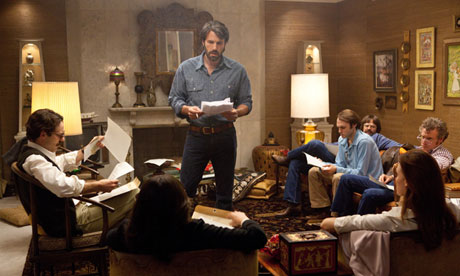
Usually, when a movie declares that it's "based on a true story," it already feels patently false. That phrase is usually code for, "We based the idea on reality, but then made the rest of it up." Argo is based on the declassified true story of a CIA agent, Tony Mendez (Ben Affleck) who concocted a harebrained scheme to free six Americans from Iran during the 1979-1981 hostage crisis. He actually told the Iranians they were a Canadian filmmaking crew scouting locations for a cheeseball sci-fi movie. I defy even the most imaginative novel writer to hatch such a plot.

Working from a great screenplay by Chris Terrio, Ben Affleck cements his status as a great actor-director. Showing great promise with his debut, Gone Baby Gone, then skillfully refining his craft with The Town, Affleck progresses to his most impressive feat of all: making a crackling thriller-comedy.

Yes, comedy. Of course, there's nothing funny at all about the Iranian hostage crisis. But there is something morbidly amusing about how this rescue unfolded. Consider that one of the operatives was makeup man John Chambers, who won an Oscar for Planet of the Apes. He's played by the always terrific John Goodman, who cracks that the target audience of a movie is "people with eyes." Matching Goodman zinger for zinger is Alan Arkin as producer Lester Siegel, who boasts that he knows Warren Beatty because he "took a leak next to him at the Golden Globes."

Juxtaposing these wiseacres with a perilous life or death rescue mission could have derailed the movie, but Affleck masterfully balances the tones. Not only does he shoot logistically complex sequences with painstaking historical detail, but he knows just when to release the tension with a well-timed joke. And in so doing, Affleck gets inside the wonder of movies as a whole. He shows how the movies are so captivating, the allure of even a fake one is enough to deter hostile Iranian guards. I daresay the mix of suspense and humor is on the level of Stanley Kubrick's Dr. Strangelove. I can only applaud a movie that throws in a reference to Muppets Statler and Waldorf.

Comparing Affleck to Kubrick is high praise indeed, but that's just how impressive Affleck's skills have become. I've already seen the movie twice, projected digitally both times. Yet Affleck fills the opening titles with the kind of speckles you'd see on a movie print from the 70s. Those don't appear in digital projection unless you put them there. So even the technical BS is a marvel. Maybe Argo fudges a few details to pump up the drama, but when the very subject of a movie is the art of lying, such deceit is commendable.


GRADE: A+


Friday, October 05, 2012

REVIEW: Frankenweenie

Going into Tim Burton's Frankenweenie scared me - and not for the right reasons.

Burton has been in a slump of late. Alice in Wonderland was hugely popular, but I couldn't see why. I thought it was cluttered whimsy that tried too hard to make sense of nonsense. HIs last film, Dark Shadows, was even worse, representing the nadir of his career. He hadn't made an A-range film since Sleepy Hollow. And his last foray into animation, Corpse Bride, was underwhelming too.

Still, I took solace in the fact that instead of grafting his twisted sensibility onto someone else's idea, Burton adapted himself. Frankenweenie began life as an animated short that got Burton, a onetime Disney animator, Hollywood attention. Now he's expanded it into a feature - and thankfully, it's kind of a return to form.

I'd stop well short of calling it a great movie. As is so often the case, Burton excels at creating worlds but stumbles creating fully realized characters. The lead character, a young Victor Frankenstein, is sweet but dull, at least for a kid who reanimates his own dog. And the other kids aren't terribly interesting either. The most fun character is the spooky science teacher, wonderfully voiced by Martin Landau, whom Burton directed to an Oscar for playing Bela Lugosi in Ed Wood.

Since the kids are rather plain, it took me a while to develop rooting interest in the story. Then, thankfully, things get really wacky when the other kids try to replicate Burton's experiment, with wonderfully bizarre results. I don't want to give away too many visuals, but I'll give you this clue - the nastiest Sea Monkeys you've ever seen.

It also helps that this material is obviously close to Burton's heart, making the emotional pull stronger as the movie goes along. And I can't help but enjoy a stop-motion animated film in black and white. Frakenweenie isn't the great movie it could have been, but it at least gives me hope that Burton's career is alive ... It's alive, it's ALIVE!


GRADE: B


PS: The 3D here is decent, but inessential. You won't miss anything if you see it flat.


Thursday, October 04, 2012

REVIEW: Pitch Perfect

They say that the quickest way to a man's heart is through his stomach. Not me. The way to this man's heart is through his ears. If a talented actress can also sing, any crush I already have only intensifies. I already had a crush on Anna Kendrick. Turns out she sings quite well. Ergo, Pitch Perfect was fun for my ears.

Yet, returning to some semblance of level-headedness that I abandoned in my lead paragraph, I must confess that Kendrick and the other actresses aside, Pitch Perfect isn't as fun as it could have been.

The movie, directed by Jason Moore of Avenue Q fame, has some of the same scrappy, perverse charm that stage musical did. It just doesn't have quite enough of it. What might have been Glee with teeth is more akin to Revenge of the Nerds with acapella and projectile vomit.

You heard me. Projectile vomit. This movie not only has several puking scenes, but the plot hinges around a bitchy leader of an acapella group (Anna Camp). She so dramatically loses her lunch, even Linda Blair would flinch. On top of that, most of the men in this movie are about as thrilling as a bottle of Kaopectate.

The gross-out jokes and for that matter, the dullard males are quite unnecessary because the girls truly carry this show - and their vocals and comic chops had me smiling broadly. As she did in Up in the Air, Kendrick plays an outwardly aloof girl who eventually softens and becomes more charming than she thought possible. This time out, though, she has a sassier side who sings a sharp version of "Cups" by Lulu and the Lampshades.

Rebel Wilson (Bridesmiads) has been touted as the movie's scene stealer, and indeed she robs them left and right. But I also liked the comic spark of Brittany Snow (Hairspray) playing Chloe, the perky singer who finds a heretofore undiscovered low register. Then there's the terminally undervalued Elizabeth Banks, one of the movie's producers, playing a singing competition commentator alongside John Michael Higgins. Clearly, these two made their lines up as they went along, and they seem to have more fun than anyone.

I wish I liked Pitch Perfect more than I did, but the movie sings more often than it croaks. Now excuse me while I download Anna's songs from the soundtrack.


GRADE: B


Monday, October 01, 2012

Combo (Sorta) Review: Looper/The Master

One thing I like about being the master of my own blog is that I can take my time with reviews if I need to. And last week, I saw two films that simply couldn't be reviewed right off the bat: Rian Johnson's Looper and Paul Thomas Anderson's The Master.

I very much admired both, but I couldn't quite wrap my viewing arms around either one, partly because both films play with time. Looper does so by dint of being a time travel thriller, while The Master's deliberate pacing made me feel like I was watching it in a state of suspended animation. Time doesn't tick by in either one of these films so much as swirl around you.

These two films wouldn't seem to have much in common, but they share one conundrum: How do you evaluate films in which the lead characters are, not to put too fine a point on it, pricks? Do you have to like films where you don't like the people? Can you?

The short answer is, sure you can. Martin Scorsese's Raging Bull centers around a particularly savage prick named Jake La Motta, and that's the one of the best films ever made. The key is either to lock into a secondary character, or to at least find the central figure a fascinating train wreck. Looper takes the former route; The Master the latter.

Since Joseph Gordon-Levitt and Bruce Willis play the same aloof, unpleasant character, it's like having two strikes rolled into one. But there are mitigating factors: the sheer charisma of both, and the emotional draw of the character played by Emily Blunt.

Levitt/Willis is not a model citizen, but it's fun and really spellbinding to watch the two of them play the same characters at different ages in the same space. But it's Blunt who really provides the emotional center of gravity in the movie as the forlorn, mysterious woman Gordon-Levitt stumbles across. She has already gone on record to say Looper is the best movie she's ever been in. I would also argue it's her best performance.

That I've spent this much time discussing the characters in a Rian Johnson film is telling. The rub against Johnson has been that he's more clever than assured as a storyteller, but Looper finally finds Johnson connecting on both visual and emotional levels. Johnson has a vivid imagination that doesn't make the future look like a variation on Back to the Future or Blade Runner - it feels lived in, even while it's turning the world upside down. The film can't escape a certain aloof quality, and Bruce Willis made a better time travel movie with 12 Monkeys, but Looper is so dizzying that I didn't always know which way was up - and that's all to the good.

I also often didn't know which way was up in The Master, and there, the disorientation is more troubling. People have complained, not unreasonably, that the lead character played by Joaquin Phoenix, is too opaque and the storytelling too elliptical. It is indeed difficult to draw a bead on a character who may be beyond redemption.

And yet, that may be precisely the point.

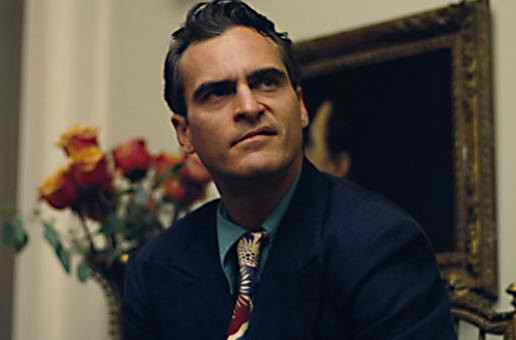
The Master is a journey into the soul of someone who seems to have lost his soul. Phoenix's Freddie Quell, a vet struggling after World War II - is certainly not unemotional - he's prone to violent outbursts. But he is also surely a man without a center of gravity, and so it might be fitting that the movie seems aimless and distant. So is Freddie.

But he's not the only lost soul here. I would also argue that Philip Seymour Hoffman's Lancaster Dodd is too, in his own way - and that's why Freddie fascinates him. Sure, Dodd is more certain of himself and what he knows - or thinks he knows - but he's also prone to outbursts whenever anyone challenges his outlandish faith. And what does it say about a man who radiates magnetism on the one hand, yet allows himself to be emasculated by his stern wife, played by Amy Adams?

This much is not in dispute: the acting is fiercely good. Hoffman is eerie yet assured, while Phoenix radiates a magnetic vibe of anxiety, of sheer intensity, that rivals that of Daniel Day-Lewis. Adams proves once Again that she's not all sweetness and light. We saw her play tough in The Fighter, here, she gets to play chilling.

Those who dismiss The Master are, I fear, being too facile. This is not a film that can be absorbed in one sitting. By the same token, It may not be a masterpiece either - it takes too many detours and leaves them dangling for that. I can't grade it right now - but I also can't shake it. That means something.

Looper: A-

The Master: Incomplete (good thing I'm not on Metacritic)


Friday, September 21, 2012

REVIEW: Trouble with the Curve

The title of Trouble with the Curve turns out to be quite appropriate for this movie. Its story certainly doesn't throw any curve balls. It's about as predictable as Lucy Van Pelt missing the fly ball in the outfield.

But in fact, I just threw a curve ball. My lead paragraph may make it sound like I didn't enjoy the movie. In fact, a very much did, because it has such an appealing cast.

Sure, regular readers of my reviews might say. You say that just because Amy Adams is in it. True enough, I do. And she's delightful as always. But she's not the only one who makes the movie fun to watch. The rest of the actors do too - so much so that it gives the lie to the idea that movie stars don't have much pull anymore. They certainly do. Perhaps they don't influence the opening weekend grosses as much as they did, but they go a long way towards making OK stories into better than OK movies.

Trouble with the Curve is notable as being the first movie starring Clint Eastwood that Eastwood didn't also direct, since 1993's In the Line of Fire. Instead, Robert Lorenz, Eastwood's producing partner takes the reigns, working with many members of Eastwood's behind the camera crew. He does a solid, if unremarkable job. He's certainly not much able to elevate the story, which might have ended up as a direct-to-disc title without its A-list cast. But what Lorenz does do well is showcase the actors a their best.

No matter where one stands on Eastwood's RNC performance, Trouble with the Curve is a bracing reminder of just how well he holds the movie screen. At first, he seems to be playing a slightly less surly version of his Gran Torino character, but this performance is more complex than that. Eastwood conveys the shifting moods of his character gracefully, with the sure hand of the old pro he is.

Justin Timberlake, playing a foil for Eastwood and a love interest for Adams proves again that he himself has screen charm to spare. His character seems grafted onto the picture to give it a romance it doesn't truly need, but his strong chemistry with Adams outshines the clichés.

Were this movie playing 70 years ago, Turner Classic Movies would be selling it today as part of their Archive Collection, meaning it's one of those movies that isn't much in and of itself, but you sure like to see the stars do their stuff. And I pitch that as a compliment.

GRADE: B+


Monday, August 27, 2012

Thoughs on Side by Side and film vs. digital


I watched Side by Side with very mixed feelings - not because the movie falls short, but because it captures a moment in time better than any documentary about movies that I have seen.

Side by Side showcases the debate between the merits of digital filmmaking versus analog filmmaking. More and more these days, films are neither made nor shown via actual film.

While I'm not sure that digital cameras have outpaced film cameras in moviemaking, digital is surely catching up. Three movies made predominantly or entirely with digital cameras, Slumdog Millionaire, Avatar and Hugo, have won cinematography Oscars. And digital projection has clearly taken over the movie theater too. Almost every theater in the Dayton area shows movies via digital projectors.

Side by Side allows some of our most prominent moviemakers to extol the virtues or decry the drawbacks of digital filmmaking. George Lucas and James Cameron are nothing less than evangelists for all things digital. Converts include such directors as David Fincher (The Girl with the Dragon Tattoo) Steven Soderbergh (Magic Mike)  and Danny Boyle (Slumdog).

Meanwhile, firmly on the pro-film side are Christopher Nolan (the Dark Knight trilogy) and his DP Wally Pfister, who insist that film offers the superior picture. Nolan went so far as to point out in the credits of The Dark Knight Rises, that it was "shot, edited and finished on film."

While Side by Side gives good weight to the analog angle, it's worth noting that there aren't more pro-film advocates like Steven Spielberg, Quentin Tarantino or Paul Thomas Anderson, who shot his latest movie, The Master, in 70 millimeter. That's a format very few theaters can even project anymore.

That's telling. And I don't think it's because all these directors believe film is better looking than digital. For many of them, it's more convenient. I noticed that most people on the pro-digital side weren't talking about the quality of the image. They were talking about technological innovations. Boyle talks about being able to get certain kinds of shots with small digital cameras. Soderbergh talks about he he didn't have to lug heavy cameras around mountains when shooting Che. Fincher loves not having to wait for dailies to see how his movie looks. And really, who's more of a visual fetishist than David Fincher?

Here's where my own viewpoint comes creeping in, and it surprises me. I love my gadgets. I love digital. Rather than carry bagloads of CDs around, I have my iPod touch. Instead of heavy books I have a light Kindle. And digital projection is fantastic. No more beat-up prints or film melting. Mo more witless teenagers looking at me funny when I tell them they've got the wrong lens on the projector.

And yet, I still find myself drawn to real film. Here's a major case in point: The Artist, my favorite film of last year. Each time I saw it, it was digitally projected. It looked beautiful, but at the same time, it felt ... "wrong," considering it evoked Hollywood's golden age. I got a similar feeling going to the classic film series in Dayton and Columbus - there was a certain comfort in knowing I was watching film of the old stuff.

So leave it to Martin Scorsese, my favorite director, to reflect my own split-down-the-middle feelings. Scorsese used digital beautifully in Hugo and yet expresses a reticence to leave film behind.

And I don't think it will be left behind - not entirely, anyway. There is absolutely no doubt digital will  dominate. But remember how in the 80s people went on and on about CDs and how vinyl would go away? Well, vinyl did go away for awhile, but these days it's making a comeback as kind of a premium audio format. I think something similar may happen with film - it will become something of a "boutique" item - abandoned by many but cherished by few. (The documentary makes a very good point that in the end, film is still the most reliable way to store films.)

Whatever medium is chosen, as Scorsese himself says, "The issue is, it's different. How is it different and how do you use it to tell a story? It's up to the filmmaker."

Side by Side is available, fittingly enough, in video on demand

Wednesday, August 15, 2012

REVIEW: The Bourne Legacy

Cast: Jeremy Renner, Rachel Weisz, Edward Norton,

Director: Tony Gilroy

Writers: Tony and Dan Gilroy

When I saw it: August 15, 2011

Where I saw it: Rave Cinemas at The Greene

Why I saw it: It's a Bourne movie. Duh.

When Universal announced plans to make a Bourne movie without Matt Damon, many people cried foul. But the problem with the underwhelming Bourne Legacy isn't that Damon is missing - it's that precious directors Doug Liman (Identity) and Paul Greengrass (Supremacy, Ultimatum)

On the surface, handing the reigns to Tony Gilroy made sense. He had a had in writing all the previous Bourne movies. He's shown himself a very capable director, with his excellent first film, Michael Clayton scoring Oscar nominations, and a win for Tilda Swinton. My only concern was that Gilroy wasn't proven as an action director.

But Gilroy stages the action very well, especially the climactic motorcycle chase. Unfortunately, there's too little action and too many plot threads, turning the first half in particular into a muddled mess. Gilroy's Achilles heel as a writer-director is that he's too fascinated with making his stories into puzzles. There are so many subplots, diversions and reversals that they obfuscate and diminish the story. That flaw kept Duplicity from being as good as it could have been, and it kept the Bourne Legacy from being as good as it should have been.

This is not to say that The Bourne Legacy is a bad movie, but I can only give it the slimmest recommendation. What keeps it afloat are the action scenes, and the performances by Jeremy Renner, Rachel Weisz and Edward Norton. All of them hold the screen extremely well, and when the relationship between Renner and Weisz finally comes to the fore, the movie finally comes alive.

At the same time, I wished that the movie were as good as that trio. I'd like to see them in another Bourne movie - hopefully with a director who is more disciplined.

GRADE: B-

Cinematographer: Robert Elswit, who is especially skilled with action, having shot Tomorrow Never Dies, Salt and Mission: Impossible Ghost Protocol

Aspect ratio: 2.35: 1

Runtime: 135 minutes

MPAA: PG-13


Wednesday, August 08, 2012

REVIEW: Hope Springs


Cast: Meryl Streep, Tommy Lee Jones, Steve Carell
Writer: Vanessa Taylor
Director: David Frankel (The Devil Wears Prada)
When I saw it: Aug. 7, 2012
Where I saw it: Rave Dayton South
Why I saw it: Love the two leads.

Quick. Think about two people older than 60 having sex.

What was your reaction? To giggle? To grimace? To understand? Or to know?

Whatever your reaction might have been, Hope Springs just might  surprise you. It certainly did me. It pulls off something even more trickier than a Christopher Nolan plot: It talks a lot about sex with people who have a lot of birthdays - and takes it absolutely seriously.

The trailer for this movie make it look like a breezy, light romantic comedy. It doesn't exactly lie - the movie is often light and breezy. But just as often, it's dramatic, moving and even revelatory.

When most movies feature older people in a sexy context, it's usually for cheap laughs, whether it's the horny grandmother in Runaway Bride or the sight of Terry Bradshaw's bare ass in the aptly named Failure to Launch. But Hope Springs is a refreshingly different animal.

Meryl Streep and Tommy Lee Jones star as a couple nearing retirement age. There's nothing really wrong with their marriage. They don't fight, they're not harboring deep, dark secrets, and they're well-adjusted to being empty-nesters.

And yet, at the same time, everything is wrong with their marriage, because whether they're willing to admit it or not, Jones and Streep are miserable. One day, Streep finds a book about how to put "that spark" back in your marriage, and she resolves to take the author's therapy, much to Jones' dismay.

It all sounds like the setup for easy, predictable laughs - oh, look, the old couple is embarrassed to talk ab out sex. Ha-ha. But as the movie goes on, it only becomes more serious - and more impactful.

This is due in no small part to the stellar cast. It's no surprise that Tommy Lee Jones and Meryl Streep can act the hell out of a scene. What is something of a surprise is to watch them do it without their usual affectations. For once, Street isn't putting on an accent, prosthetics, or a giant attitude. Jones doesn't try to get laughs just by being deadpan. Both of them are playing utterly normal people - and that only makes their performances more engaging. The same, too, must be said for Steve Carell, who has a knack for playing button-downed, stressed out geeks. Here, he plays the role of the doctor absolutely straight - and is wonderfully empathetic as a result.

I was only sorry to see Elisabeth Shue playing such a tiny, inconsequential part as a barmaid. Considering her stature, it was disappointing to see her in what amounted to a walk-on role with only about four lines. I can only guess that her role must have been downsized in the editing room. Considering how well the movie turned out, I wanted to see more of her.

It's also gratifying to see the screenplay not resort to all the old cliches. There's not a tearful confession about some heretofore untold sins of the past. There's no scene with the grown-up kid being the wise old sage. This is a movie about two people trying to learn to love one another again and finding out that's easier said than done.

One could argue the movie ends a little too neatly, but regardless, this is a sleeper that's bound to wake more than a few couples up. In an age where sex talk is reduced to sniggering over 50 Shades of Grey, it's nice to see instead men and women of many more shades.

GRADE: A-

Cinematographer: Florian Ballhaus, son of Michael Ballhaus, whose credits include Goodfellas and The Departed
Aspect ratio: 2.35: 1
Runtime: 100 minutes
MPAA:  PG-13, which is a little surprising considering the sex talk is rather frank.